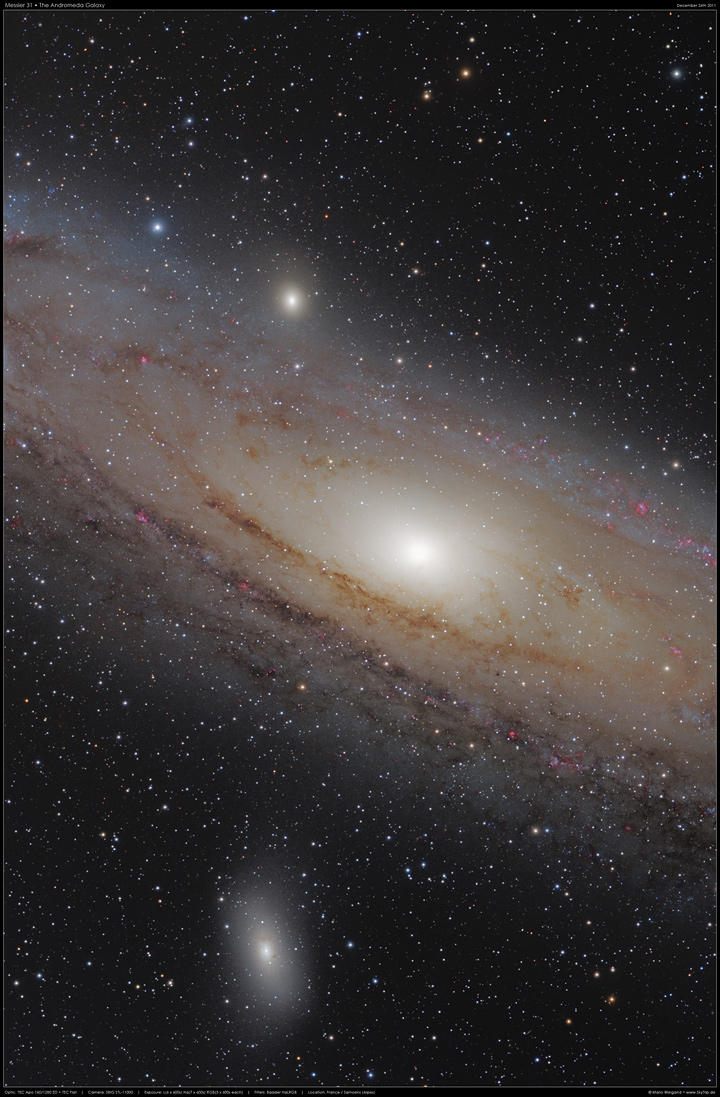
Messier 31 • die Andromeda-Galaxie mit M32 und M110
Kommentar: Hin und wieder kann man den schon so oft abgelichteten Standard-Objekten nicht widerstehen,
erst recht, wenn man eine neue Optik einweiht... So musste einmal mehr M31 herhalten, diesmal quasi in Nahaufnahme
als erstes Deep Sky-Bild mit dem TEC 160 + Flattner.
Mit der SBIG STL-11000M wurde rund 1 Stunde für Luminanz,
30 Minuten je Farbe und 70 Minuten für H-Alpha belichtet. Letzteres, um die HII-Regionen mehr zu betonen. Das Seeing war nicht
das allerbeste, jedoch stand M31 fast im Zenit, was brauchbare Rohdaten zuließ.
Ältere Aufnahmen mit mehr Gesichtsfeld sind weiter unten verlinkt.
Hinweis: In den großen Versionen des Bildes und auch im Ausschnitt unten erkennt man eine Art Körnigkeit in den Spiralarmen.
Dies ist kein Rauschen, sondern bereits die grob aufgelöste Sternverteilung!
Andromeda IV
Ich möchte an dieser Stelle noch auf eine Besonderheit hinweisen.
Die Aufnahme zeigt neben M32 und M110 auch noch eine weitere Zwerggalaxie des Andromedasystems: Andromeda IV (siehe Ausschnitt unten).
Sie ist rund 15' südöstlich von M32 zu finden, in der Aufnahme links oberhalb.
Es handelt sich dabei nach aktuellen Einschätzungen um eine irreguläre Zwerggalaxie, jedoch ist es möglicherweise auch nur um eine abseits liegende Sternwolke.
And IV wurde erst 1972 mit dem 1,2-Meter-Teleskop des Palomar Observatoriums entdeckt.
Entdecker war Sidney van der Bergh, der während einer Durchmusterung auf das diffuse Objekt stieß.
Mit der SBIG STL-11000M wurde rund 1 Stunde für Luminanz, 30 Minuten je Farbe und 70 Minuten für H-Alpha belichtet. Letzteres, um die HII-Regionen mehr zu betonen. Das Seeing war nicht das allerbeste, jedoch stand M31 fast im Zenit, was brauchbare Rohdaten zuließ. Ältere Aufnahmen mit mehr Gesichtsfeld sind weiter unten verlinkt.
Hinweis: In den großen Versionen des Bildes und auch im Ausschnitt unten erkennt man eine Art Körnigkeit in den Spiralarmen. Dies ist kein Rauschen, sondern bereits die grob aufgelöste Sternverteilung!
Andromeda IV
Ich möchte an dieser Stelle noch auf eine Besonderheit hinweisen. Die Aufnahme zeigt neben M32 und M110 auch noch eine weitere Zwerggalaxie des Andromedasystems: Andromeda IV (siehe Ausschnitt unten). Sie ist rund 15' südöstlich von M32 zu finden, in der Aufnahme links oberhalb.Es handelt sich dabei nach aktuellen Einschätzungen um eine irreguläre Zwerggalaxie, jedoch ist es möglicherweise auch nur um eine abseits liegende Sternwolke. And IV wurde erst 1972 mit dem 1,2-Meter-Teleskop des Palomar Observatoriums entdeckt. Entdecker war Sidney van der Bergh, der während einer Durchmusterung auf das diffuse Objekt stieß.
Galaxien-Typen
Weitere Bilder: Objekte der Lokalen Gruppe
Links zu Messier 31
Links zu Messier 32
Links zu Messier 110
Links zu Andromeda IV